


Tesla’s Soul Vision: Why We’re Not Just Buying a Car—We’re Joining the Future
- Jul 29, 2025
- 30 min read
Updated: Oct 28, 2025

Why Tesla Isn’t Just a Car Company—It’s a Cultural Pulse of Acceleration

Most automakers build cars.Tesla builds something else entirely:
A movement. A myth. A mindset.
In a world where innovation is often incremental, Tesla dares to leap.It doesn’t just ride market trends—it bends them.And whether you admire it or critique it, one thing is clear:
Tesla isn’t just a product. It’s a signal.
It signals speed, disruption, and the willingness to question everything.From the way cars are powered to how cities are built to what it means to “own” technology—Tesla keeps asking:
What if the future could get here faster?
And whether you're a shareholder, a skeptic, or just someone who's watched a Cybertruck ad with wide eyes, you already know—
Tesla’s Evolution at a Glance
A 10-Year Transformation: 2014–2024
Year | Milestone | Context / Impact |
2014 | Model S gains traction | Proves EVs can be desirable, fast, and luxurious |
2015 | Powerwall introduced | Marks Tesla’s entry into the home energy ecosystem |
2016 | Acquisition of SolarCity | Vertical integration of solar energy; strategy begins to form |
2017 | Model 3 begins production | Tesla’s move toward mass market EVs — critical for scale |
2018 | Production hell → Breakthrough | Model 3 production stabilizes; stock begins long-term climb |
2019 | Shanghai Gigafactory opens | First foreign-owned car plant in China — accelerates global reach |
2020 | First annual profit & inclusion in S&P 500 | Signals Tesla’s transition from promise to performance |
2021 | Record deliveries, market cap exceeds $1 trillion | Tesla becomes one of the most valuable companies in the world |
2022 | Berlin and Texas Gigafactories go live | Expands capacity, strengthens geopolitical manufacturing strategy |
2023 | FSD Beta expands + Dojo AI chip progress | Accelerates toward autonomy; infrastructure for scalable AI begins to form |
2024 | Cybertruck enters production, energy division scales | Tesla matures into a full-spectrum energy-tech company |
The Business Model:
Vertical Integration as Tesla’s Core Identity

Most companies outsource to simplify.Tesla integrates to accelerate.
It doesn’t just build cars.It builds the system that builds the car.Then it questions that system—and builds that too.
From batteries and AI chips to gigafactories and software stacks, Tesla’s obsession with vertical integration isn’t a tactic.
It’s a worldview.
Why This Matters: Control. Speed. Differentiation.
Tesla’s vertical stack gives it three superpowers:
Speed of Innovation
When Tesla wants to launch a new battery chemistry, redesign drivetrain architecture, or tweak FSD code…There’s no middleman.
It doesn’t ask for permission. It builds the update.
While legacy OEMs negotiate with a dozen suppliers, Tesla just deploys—and iterates in real time.
Cost Optimization at Scale
Gigafactories aren’t just big—they’re strategic compression engines.
By consolidating the global EV supply chain under one roof, Tesla cuts:
Freight time
Supplier markup
Procurement drag
Then it reinvests those savings into what matters most:R&D. Price flexibility. Competitive resilience.
Software-Hardware Symbiosis
Tesla doesn’t rely on third-party code. It writes its own.
Every line of Autopilot logic.Every OTA update.Every inch of the in-car interface.
It’s not just a vehicle. It’s a living platform.
That’s why your Tesla can get smarter overnight—just like a phone.Because it’s more than hardware.It’s a software stack on wheels.
Gigafactories: Factories with a Philosophy
Tesla’s Gigafactory strategy isn’t just about output.It’s about identity replication.
Each Gigafactory—from Nevada to Berlin to Monterrey—is:
A closed-loop ecosystem
A symbol of independence
A blueprint for global duplication
Tesla isn’t just exporting cars. It’s exporting its manufacturing religion.
From lithium refining to painting, nearly every step happens inside.What others scatter, Tesla synchronizes.
Strategic Takeaway: Tesla Builds the Builders
Most companies optimize for cars.Tesla optimizes for capability.
Its moat isn’t just the Model 3 or the Supercharger.It’s the way everything connects:
The chip that powers the autonomy
The software that feeds the chip
The factory that builds the chip
The supply chain that feeds the factory
And the leadership that refuses to settle for “good enough”
In Tesla’s world, "build" isn’t a department.
It’s a culture.
It doesn’t just deliver products.It delivers acceleration—of process, of possibility, of belief.
4680 Battery: From Raw Materials to Reinvention

When Tesla introduced the 4680 battery, it wasn’t just a product launch.It was a line in the sand.
This isn’t a component. It’s a commitment.A commitment to vertical integration—not as a strategy, but as a survival instinct for the next energy age.
What Is the 4680—and Why It Matters
The name comes from its dimensions (46mm x 80mm), but the real story is what’s inside—and what it changes.
Unlike traditional cylindrical cells, the 4680 is:
Bigger → more energy in fewer units
Smarter → tabless design reduces resistance and overheating
Cheaper → cost per kilowatt-hour drops as scale ramps
Stronger → integrated into the vehicle’s structure, not just bolted underneath
It doesn’t sit in the car. It becomes the car.
Tesla Doesn’t Just Make the Battery—It Builds the Whole Supply Chain
Traditional automakers buy their batteries.Tesla builds theirs.
From raw lithium and nickel sourcing to cell coating, electrolyte chemistry, and pack assembly—Tesla is taking it all in-house.
Why?
Because if you control the battery,
you control the performance.You control the price.You control the pace.
Vertical Integration, Cell by Cell
This isn’t just efficiency—it’s sovereignty.
Tesla’s 4680 ecosystem includes:
Pilot lines in Fremont → testing new chemistry at rapid cadence
Scaling in Texas and Nevada → building gigawatt-hour capacity, fast
Future playbooks → lithium refining, cathode processing, even direct extraction
Every piece Tesla insources is one less bottleneck, one less delay, one more lever of control.
Why This Changes the Game
Legacy automakers treat batteries like a line item.Tesla treats them like DNA.
With the 4680, Tesla gains:
More range
Faster charging
Safer thermal profiles
Lower cost
Higher manufacturing agility
But more than that—it gains independence.
No more commodity shockwaves.No more fragile logistics.No more innovation bottlenecks.
Just speed. Scale. And self-reliance.
Strategic Takeaway: Owning the Energy Stack
4680 is more than a cell. It’s a symbol.
It shows what happens when a company stops asking for parts—and starts building the entire system itself.
This cell isn’t just about making EVs better.
It powers Tesla’s next decade: from cars to Powerwalls, from robots to AI clusters.
Gigafactory Strategy: Supply Chain Sovereignty at Industrial Scale

Most automakers manage supply chains.Tesla architects them.
From Parts Assembly to Ecosystem Construction
When traditional OEMs face global disruptions, they scramble for alternatives.When Tesla faces them, it rewrites code, reconfigures lines—and keeps going.
Why?
Because it doesn't just manufacture products.It manufactures the means of production.
Tesla’s Gigafactories aren’t factories in the classic sense.They are supply chain fortresses—consolidating raw material processing, component fabrication, final assembly, and software integration under one massive roof.
“Materials in. Cars out.”It’s not a metaphor. It’s a blueprint.
Old World vs. Tesla’s World
Traditional OEM model:
400+ third-party suppliers
Dispersed factories across continents
Chain reaction delays from a single missing part
Tesla’s Integration model:
Core components made in-house
Software + battery + motor + chassis in one synchronized loop
Autonomy in iteration, speed, and crisis response
This isn’t just about vertical integration.
It’s defensive design in a volatile global system.
When the chip shortage froze the industry, Tesla didn’t wait.It reprogrammed in-house chips and delivered.That’s not agility. That’s architecture.
Global Vision, Local Precision
Every Gigafactory is more than a building—it’s a node in a living global infrastructure, each tuned for local advantage, yet part of a synchronized Tesla tempo.
Giga Nevada → Batteries, drive units, energy storage
Giga Shanghai → Asia-Pacific hub, hyper-efficient scaling
Giga Berlin → Europe’s tech-forward showcase
Giga Texas → Cybertruck, 4680 ramp-up, Dojo AI hardware
Giga Mexico (in development) → Low-cost, high-efficiency manufacturing base
Each location is handpicked not just for land and tax—but for supply proximity, talent density, geopolitical diversification, and futureproofing.
Tesla isn’t placing factories.It’s placing power.
Strategic Takeaway: Factories as Moats
Tesla’s factories are its flywheels.
They compress timelines, eliminate handoffs, and create feedback loops between product and process that no legacy automaker can match.
Speed → Design-to-delivery cycle slashed
Resilience → In-house supply chains shield from shocks
Margin power → Cost layers removed, value captured
Where others outsource risk, Tesla internalizes advantage.
Because in Tesla’s philosophy, the real innovation isn’t in the showroom.
It’s on the factory floor.And the factory is the product.
Energy + Software: Building the Tesla Ecosystem Beyond the Car

Most automakers stop at the driveway.Tesla starts there.
It doesn’t just build vehicles.It builds the entire infrastructure that keeps them moving—and powers your home in the process.
This isn’t diversification. It’s orchestration.
From rooftop solar to home batteries to the global Supercharger grid, Tesla is crafting a closed-loop energy ecosystem, unified by one thing:Software.
Solar + Powerwall: Energy Independence, Installed
When Tesla acquired SolarCity in 2016, skeptics called it a distraction.Tesla called it destiny.
Now, that vision has taken shape:
Solar Roof: Aesthetic solar tiles that look like shingles, not panels
Traditional Solar Panels: Low-profile, high-efficiency home generation
Powerwall: A sleek, smart battery storing your own solar power for night or grid outages
And the control center?
The same Tesla app that unlocks your car…now powers your house.
The house becomes the battery.Not just a consumer of energy—but a generator, a storehouse, a node in a smarter grid.
Tesla’s real innovation? Making independence look effortless.
Supercharger Network: Infrastructure as Brand Gravity
While others wait for governments and third parties to build charging infrastructure, Tesla did what it always does:
Built its own.
Fastest charge times in class → up to 200 miles in 15 minutes
Integrated routing → no range anxiety
In-app payments → no RFID cards, no third-party delays
But the Supercharger network is more than fast—it’s everywhere.And it’s now open to non-Tesla vehicles in select markets.
Tesla turned its infrastructure into a platform.Then turned that platform into a profit center.
By controlling the full charging experience, Tesla doesn’t just make EV ownership easier.It defines what “easier” looks like.
Software Is the Glue—and the Edge
All of Tesla’s energy and mobility products are tied together through one interface:Software.
And not just any software—Tesla’s own codebase, in-house developed and iterated.
The Tesla app unifies car, home energy, solar production, and battery storage
Over-the-air updates keep your home grid smart and evolving
Real-time energy analytics help optimize consumption, feed power back to the grid, or join virtual power plants (VPPs)
This isn’t just product bundling.It’s interface design for energy sovereignty.
Tesla doesn’t just make “smart homes.”It makes homes with agency.
Strategic Takeaway: From Vehicle Sale to Lifetime Value Loop
Tesla isn’t aiming to win the next car purchase.
It’s aiming to own the next decade of your energy life.
You buy a car
That car connects to your home
Your home generates and stores energy
You charge via a proprietary network
And manage everything from the palm of your hand
Each step is monetized.Each piece strengthens the next.
The result? A customer journey that’s no longer transactional—it’s transformational.
Software-as-a-Margin: From Hardware Sales to Recurring Revenue

Most automakers build cars.Tesla builds platforms.
And here’s the real shift:
You don’t just buy a Tesla once. Tesla earns from you, again and again—with no factory labor, no new parts, just software.
This is the core of Tesla’s next frontier:Margins that scale with intelligence.
Autopilot & FSD: Monetizing What’s Already Built
Tesla’s flagship software product—Full Self-Driving (FSD)—is not a feature.It’s a recurring revenue engine embedded in every vehicle.
Here’s how it works:
Autopilot comes standard (lane-keeping, adaptive cruise control)
Users can upgrade to FSD for advanced features: Navigate on Autopilot, Summon, Smart Parking
FSD is priced at $12,000 one-time, or $199/month subscription
But here’s the genius:
Every car ships with the same FSD-capable hardware.The difference? It’s locked behind a digital paywall.
Which means: no new parts, no additional manufacturing—just revenue through code.This is margin without inventory.
And because FSD improves via over-the-air updates, the product gets better while the price stays high—or goes up.
Over-the-Air Upgrades: Revenue at Zero Marginal Cost
In the traditional model, once the car leaves the lot, the revenue ends.In Tesla’s model, delivery is just the beginning.
Tesla delivers regular software upgrades that:
Increase acceleration or range
Add new entertainment options (streaming, games)
Improve safety features and UI
Offer premium connectivity and cloud features
Each one is:
Instantly deployable
Globally scalable
High-margin
And entirely digital
Tesla treats your vehicle like a smartphone—with unlockable features, updates, and subscriptions.
That turns each car into a recurring revenue device.
Beyond Driving: Expanding the Digital Storefront
The Tesla App isn’t just for unlocking your car.It’s becoming a commerce layer for Tesla services:
Insurance: Personalized rates based on driving data
In-app upgrades: One-tap performance or feature boosts
Connectivity subscriptions: Wi-Fi, music, traffic, and cloud sync
Future add-ons: Vehicle personalization, AI services, possibly ride-hailing
This isn’t “optional.”It’s designed behavior—a system that invites continual engagement.
Strategic Takeaway: Scaling Margin, Not Just Output
The magic of this model?
Unlike legacy automakers, Tesla’s margin isn’t capped by factory throughput or labor hours.
Instead, every new vehicle becomes:
A recurring subscriber
A data node that improves the AI
A sales portal for energy, upgrades, and insurance
A feedback loop that sharpens future innovation
The result?A software flywheel embedded in steel—spinning faster with every delivery.
Tesla Insurance: Turning Driving Into a Revenue Loop

Most insurers rely on your credit score.Tesla relies on your actual driving.
And that one shift changes everything.
When your vehicle knows exactly how you drive—it doesn’t guess your risk. It knows it.
That’s the foundation of Tesla Insurance—a system that turns real-time behavior into real-world pricing.
How It Works: Insurance Meets Intelligence
Tesla uses data collected from your vehicle’s onboard sensors to assess risk dynamically. No agents. No vague scoring.
The system monitors:
Braking force
Cornering habits
Nighttime driving frequency
Autopilot engagement
Acceleration patterns
This creates a real-time Safety Score, unique to each driver, which determines your insurance premium.
Drive better? Pay less.Drive recklessly? The car knows.
Why It Matters: Data, Margin, and Retention
Unlike traditional insurers, Tesla owns the hardware, the software, and the behavioral data. That unlocks three competitive advantages:
Lower cost of operations – no agents, no underwriting layers
Better pricing – Tesla doesn’t estimate risk; it measures it
Higher retention – Safe drivers stay, and they stay longer
But the real power is structural:
Tesla transforms what used to be a liability (accidents) into an asset (data-informed pricing).
Insurance becomes more than a sideline—it’s a reinforcing feedback loop for safety and engagement.
Strategic Takeaway: Safety Isn’t Just Moral. It’s Monetizable.
In the Tesla ecosystem, the more responsibly you drive, the more value you unlock—not just in savings, but in experience.
This is insurance as a behavioral layer—one that:
Incentivizes good habits
Feeds AI learning systems
Strengthens user lock-in
And the best part?
It’s all built on systems Tesla already controls—turning invisible data into visible dollars.
Dojo AI: Tesla’s Next Platform Isn’t a Car—It’s a Cloud
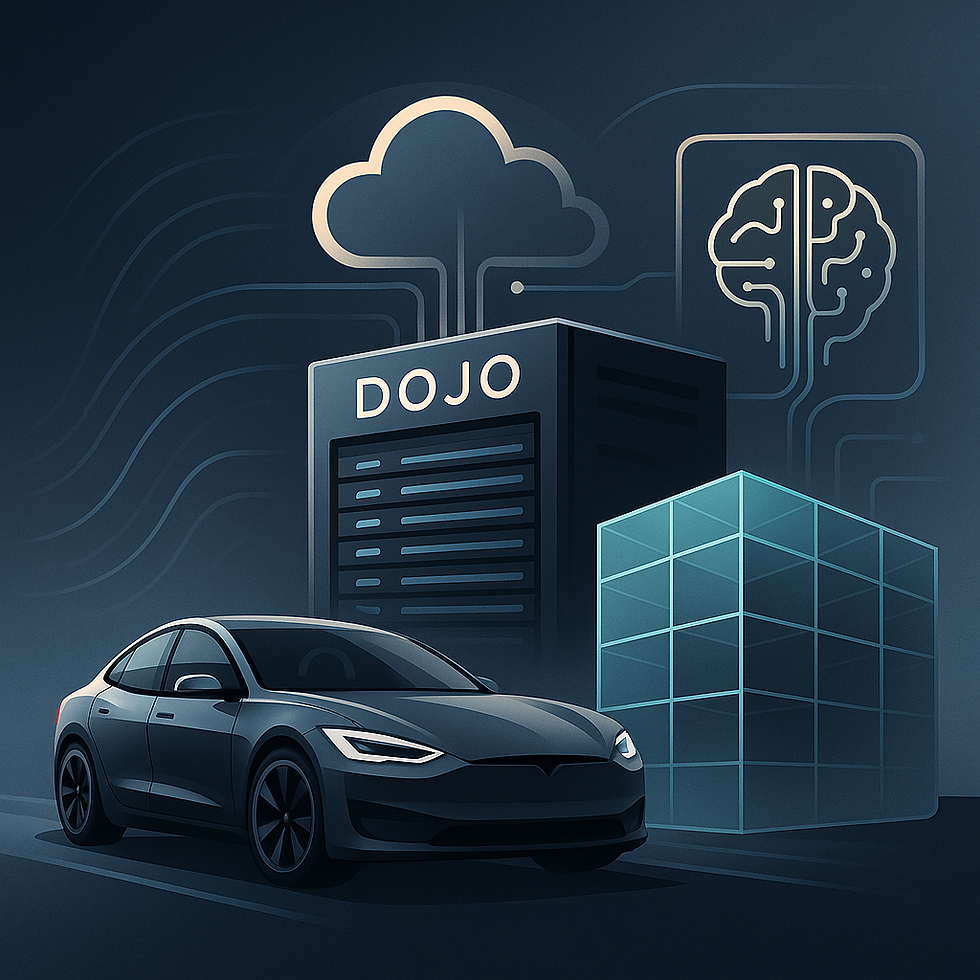
Most carmakers worry about improving GPS.Tesla trains supercomputers.
That’s the scale shift behind Dojo—Tesla’s in-house AI training supercomputer, born from the need to process massive driving data from millions of vehicles on the road.
But what started as an internal tool is rapidly evolving into something much bigger:
A cloud-scale platform to rival Nvidia’s GPUs and AWS’s compute power—without relying on either.
Why Build Dojo? Because Tesla Outgrew the Grid
Tesla's fleet generates petabytes of data daily—from road conditions to pedestrian behavior to split-second steering inputs.
Training neural nets at that scale requires:
Massive computing power
Low latency
Full-stack control
So Tesla did what Tesla always does: build in-house.
They created their own silicon. Optimized the architecture. And aligned software + hardware like few companies can.
What This Unlocks: A Platform Beyond Vehicles
Dojo isn’t just about cars. It’s about infrastructure dominance in one of the fastest-growing markets: AI compute.
Tesla could soon offer:
AI-training-as-a-service to external developers
Cloud compute optimized for robotics, energy systems, or autonomous devices
Edge AI processing that supports smart homes, factories, or cities
In other words, Tesla’s “car company” is now a contender in cloud AI infrastructure.
Strategic Takeaway: From Roadmap to Data Map
With Dojo, Tesla is turning vehicles into sensors, data into assets, and compute into business models.
And unlike traditional AI players, Tesla owns the feedback loop—from real-world driving data to chip design to neural net deployment.
That means:
No dependency on Nvidia
No leasing AWS time
No waiting for external innovation
In-App Ecosystem: Tesla’s Interface Is the New Storefront

Most car apps let you unlock the doors.Tesla’s app lets you unlock new dimensions.
It’s not just a dashboard—it’s a dynamic platform that sells, services, scores, and syncs every layer of the Tesla experience.
A Commerce Engine in Your Pocket
Within one interface, users can:
Buy performance boosts with a tap—no garage visit required
Subscribe to Full Self-Driving or Premium Connectivity
Schedule service, track vehicle health, or diagnose remotely
Monitor solar generation + Powerwall usage in real time
Access Tesla Insurance, including behavior-based premium tracking
This isn’t a car app.
It’s a control panel for an electrified lifestyle.
And with every software update, it gets smarter, deeper, more monetizable.
The App Store Model, Reinvented for Mobility
What Apple did with phones, Tesla is doing with cars and homes:
Turn one-time buyers into ongoing customers
Build a platform for upgrades, not just replacements
Deliver new value without touching the hardware
A Tesla isn’t “done” when it leaves the factory. It evolves—with every tap, every mile, every insight.
Strategic Takeaway: Tesla Isn’t Just Vertical—It’s Layered
Tesla doesn’t just integrate operations.It stacks business models.
A product you drive
A platform you subscribe to
A utility you depend on
A commerce layer you live in
This is not vertical integration in the traditional sense.This is vertical monetization—at the intersection of hardware, software, and user behavior.
The Technological Edge:
Tesla Doesn’t Just Build Tech—It Shapes the Future

Most automakers respond to trends.Tesla writes them.
From battery cells to AI chips, from self-driving neural networks to an energy ecosystem that wraps around your life—Tesla doesn’t just innovate to differentiate.It innovates to define what’s next.
This isn’t a company asking “Will the future arrive?”It’s asking:
“If the future is already here—how do we build it?”
4680 Battery: Power Isn’t Just Stored—It’s Engineered
The 4680 battery wasn’t just a new cell.It was a declaration of autonomy.
Named after its dimensions—46mm wide, 80mm tall—the 4680 cell reimagines the entire physics of storage:
5× more energy
6× more power output
~16% more range at the vehicle level
Tabless design → better thermal control, faster charging
Structural role → integrated into the car’s chassis, improving strength and efficiency
But here’s what really matters:
Tesla isn’t just buying batteries. It’s building them—from the molecule up.
Tesla now owns everything from raw material sourcing and chemical refinement to electrode coating and cell assembly—in-house. That’s not just vertical integration.It’s supply chain sovereignty.
Autopilot & FSD: Intelligence That Learns While You Drive
Every Tesla is more than a car.It’s a sensor platform—training its AI with every mile.
While competitors rely on expensive LiDAR, third-party maps, and simulations, Tesla bets on vision, powered by custom AI chips and trained by Dojo, its supercomputer built for neural learning.
Here’s what sets Tesla apart:
Real-world learning, not just lab scenarios
Edge-case adaptation from billions of real miles
Instant updates via OTA (Over-the-Air) delivery
Fleet-wide feedback loop that trains the entire system together
Autonomy isn’t just a feature. It’s a compounding advantage.
Every user interaction makes Tesla’s FSD (Full Self-Driving) system smarter, faster, safer—creating an exponential learning curve few can match.
Dojo: Tesla’s Brain, at Superhuman Scale
While others rent cloud capacity, Tesla builds the cloud.
Dojo is Tesla’s in-house AI training supercomputer, designed specifically to train vision-based neural networks using petabytes of video data from Tesla’s global fleet.
This matters because:
No bottlenecks from NVIDIA or AWS
Tailor-made chips and instruction sets
Scalable architecture for future robotics and beyond
If Tesla opens Dojo as a service, it could become a cloud provider for autonomy—across industries like logistics, robotics, and smart infrastructure.
Dojo isn’t just Tesla’s AI engine. It’s potentially Tesla’s AWS.
Over-the-Air Updates: The Car That Evolves
Traditional automakers treat a car like a finished product.
Tesla treats it like a living, breathing organism—pushed forward by code.
With OTA updates, Tesla can:
Add new features, like faster acceleration
Improve energy efficiency and safety
Introduce games, light shows, and UI upgrades
Fix bugs or respond to real-world challenges—overnight
This is software not as a patch, but as evolution.
A Tesla off the lot is just the beginning. The best version is yet to come.
Strategic Insight: Innovation as a Feedback Loop
Here’s the difference:
Most automakers release, forget, and replace.
Tesla deploys, learns, and evolves.
With every mile driven, the product improves.With every improvement, users stay longer.And with every update, Tesla moves further ahead—not just in technology, but in trust, engagement, and user belief.
This is Tesla’s true tech edge:It’s not just building the future.It’s teaching it to grow.
Hardware & Software, Built as One:
Tesla’s Integrated Tech Stack

Most car companies source chips.Tesla engineers them.
This isn’t just a manufacturing decision.It’s a philosophy.
Where legacy automakers draw a line between hardware and software, Tesla erases it. It co-develops them—like brain and body, fused in function, inseparable by design.The result? A car that doesn’t just drive—it evolves.
Tesla Chips: Built for the Machine, Not the Market
At the core of every Tesla is something extraordinary: a neural network chip built in-house.Not bought. Not licensed. Invented.
Unlike competitors who depend on off-the-shelf processors, Tesla’s custom silicon is purpose-built for one mission:
Real-time vision. Split-second decision-making. EV battery precision.
These chips power everything from Full Self-Driving (FSD) inference to energy optimization—and they do it with:
Ultra-low latency
Low energy draw
Custom logic for behavior prediction
No middlemen. No waiting on suppliers. No compatibility issues.Just code meeting metal—seamlessly.
This is hardware that speaks Tesla’s native language.
Automation: Factories That Think Like Coders
At Tesla’s Gigafactories, production isn’t about assembly lines.It’s about algorithms.
Inside these temples of scale, AI and machine learning aren’t add-ons—they’re embedded logic.
Robots coordinate using proprietary casting systems
Computer vision checks for quality in real-time
Virtual twins simulate layout and workflows before a single part is cut
And then there’s the showstopper:
Giga Press—the world’s largest casting machine, compressing hundreds of parts into one solid frame.
Fewer parts. Fewer welds. Fewer delays.More strength. More speed. More elegance.
This isn’t just automation—it’s industrial art, optimized by software.
Strategic Punchline: Tesla Doesn’t Build Cars—It Builds Intelligence
Tesla’s hardware isn’t static.It listens. It learns. It levels up.
Because when the same team designs the chip, the code, and the casting robot—the whole vehicle becomes a single, living organism.
Not just a machine—but a system that improves itself, pixel by pixel, line by line, mile by mile.
While other automakers optimize parts, Tesla optimizes potential.
And that’s why in the Tesla universe…
Hardware isn’t the limit.It’s the launchpad.
Development Velocity:
Where Tesla Breaks the Clock

Most automakers move in years.Tesla moves in weeks. Sometimes—in days.
In a legacy auto world where five- to seven-year development cycles are the norm, Tesla rewrites the calendar.Not by cutting corners, but by redefining how quickly innovation can become reality.
“Why wait to be ready, when you can learn by doing?”
—
A Silicon Valley Cadence in a Detroit Industry
Tesla’s development rhythm looks more like a tech startup than a traditional automaker:
Rapid prototyping of hardware and software simultaneously
Over-the-air updates that push new features weekly, not annually
Live beta testing of Autopilot & FSD through real-world user feedback
In-house verticals that eliminate supplier drag
This isn’t speed for its own sake.It’s speed that compounds learning.
“Every mile driven is another line of code improved.”
The Flywheel Effect: Real-World Feedback, Real-Time Evolution
Every Tesla on the road is a rolling lab.
With nearly 5 million+ connected vehicles, Tesla gains access to a live stream of:
Road edge cases
Driver behaviors
Climate-based performance variables
Mechanical stress points under real conditions
This data doesn’t sit on a shelf—it trains Dojo, improves code, and loops back into updates.
“What other automakers simulate in labs, Tesla learns from reality.”
While Others Launch Yearly—Tesla Evolves Overnight
Legacy OEMs might release one or two updates per year—after months of regulatory loops and dealership alignment.
Tesla?
Deploys UI upgrades, bug fixes, and performance boosts across the entire fleet—often overnight
Has turned its vehicle into a living organism, not a static product
Can respond to issues before customers even report them
“It’s not just engineering agility. It’s customer intimacy—at scale.”
Strategic Insight: Tesla Doesn’t Just Build Fast—It Learns Fast
Tesla’s advantage isn’t just first-mover status or vertical integration.It’s development velocity as a mindset.
Because in this industry, whoever learns fastest—wins longest.
And Tesla doesn’t measure success by the calendar.It measures it by iteration.
Innovation Compounding at the Edge
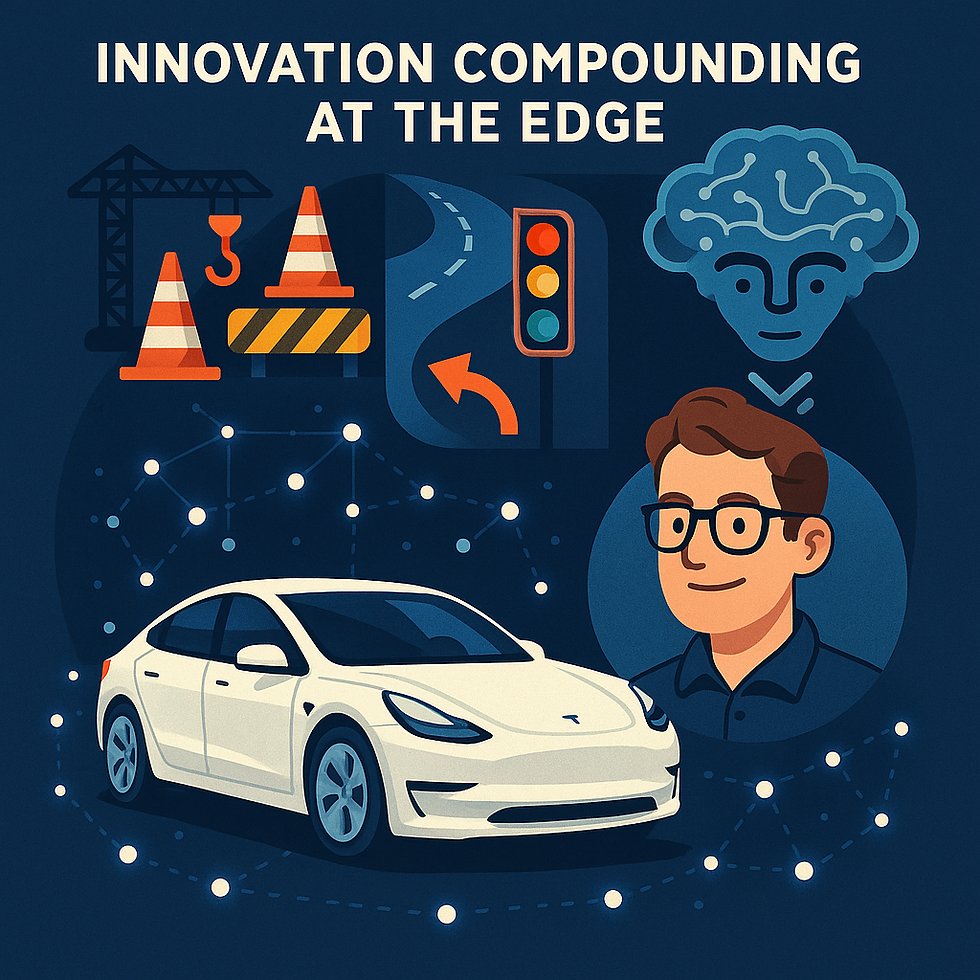
Where every anomaly becomes an asset.
Most automakers dread edge cases.Tesla trains on them.
In a traditional R&D loop, the unexpected is treated like noise.At Tesla, the edge is where the signal lives.
“Every odd turn, every unclear lane, every blinking construction light—adds intelligence.”
—
Real-World Learning, Fed to a Supercomputer
Through its global fleet, Tesla collects petabytes of video data, daily.
That data gets streamed into Dojo—its custom-built AI supercomputer—where:
Edge-case scenarios are labeled in hours, not months
Driving behaviors across climates, cultures, and conditions are normalized
Neural nets are retrained continuously, then pushed back into the fleet
This isn’t just feedback.It’s compounded learning—looped at scale.
“What takes others years of lab work, Tesla absorbs in a single software cycle.”
—
From Brakes to Brains: How Edge Data Refines Everything
Because the vehicle is fully digitized, Tesla can track and refine performance at the micro-level:
Regenerative braking algorithms adjusted in extreme climates
Energy optimization for stop-and-go traffic in dense cities
UI tweaks based on driver interaction patterns
Every interaction becomes a datapoint.Every datapoint becomes a smarter decision engine.
“The edge isn’t a problem. It’s where the product becomes personalized.”
—
Strategic Insight: Tesla Doesn’t Just Scale Products—It Scales Intelligence
Other companies launch and hope to learn.
Tesla launches to learn.
Its edge isn’t just technological—it’s philosophical:
The more chaos it sees, the calmer it becomes.Because in Tesla’s system, intelligence compounds—not in silence, but in motion.
Brand vs. Person: The Elon Musk Factor

Most companies are judged by their products.Tesla is judged by a person.
Elon Musk isn’t just the CEO—he’s the mythos, the amplifier, the lightning rod.His name alone can send Tesla stock soaring… or plunging.
He tweets like no one’s watching. He makes promises few dare to make.And somehow, that chaos doesn’t weaken the brand—it feeds it.
"If you buy a Tesla, you’re not just buying a car. You’re buying into Elon’s vision of the future."
This is brand as cult of personality.
Where other companies hide their leadership behind layers of corporate calm, Tesla leans into the volatility. It thrives on it.To be a Tesla fan is to tolerate contradiction: visionary breakthroughs and public stumbles, moonshots and memes.
Because for better or worse—Elon is the product.The sense of boldness, friction, unpredictability?It isn’t a marketing tactic. It’s cultural code, passed down from the top.
Strategic Insight: Charisma Scales Until It Doesn’t
In the short run, Elon is Tesla’s greatest asset—he drives attention, rallies believers, and expands the story faster than any ad campaign ever could.
But in the long run?
That same centrality could become a risk.As Tesla grows into a utility-scale, global infrastructure company, the question becomes:
Can the myth mature without losing the magic?
Tesla’s biggest leadership challenge isn’t building technology.It’s decoupling belief in the product… from dependency on the man.
The ESG Paradox: Sustainability Meets Scrutiny

On the surface, Tesla is an ESG darling:Zero-emission vehicles. Solar energy. Battery storage that replaces dirty grids.
But ESG isn’t just about what you build—it’s about how you build it.And that’s where things get complicated.
“Saving the planet is hard to square with labor lawsuits and social firestorms.”
Tesla’s environmental impact is undeniable.Yet its governance and social practices have raised eyebrows:
Allegations of unsafe working conditions at factories
Accusations of union suppression
Controversies over diversity, pay equity, and corporate transparency
Elon Musk’s personal actions and polarizing rhetoric
These aren’t just PR risks—they’re scorecard variables that increasingly influence access to capital, institutional investment, and inclusion in ESG indexes.
In 2022, Tesla was removed from the S&P 500 ESG Index.Not because its products weren’t green—But because its operational behavior wasn’t aligned with ESG expectations.
Strategic Insight: You Can’t Out-Innovate Perception
Tesla wants to lead the future.But leading the future also means embodying its values—fully, not selectively.
ESG isn’t a checkbox—it’s a mirror.And right now, that mirror reflects a paradox:
A company that’s solving planetary problems… while creating human-scale controversy.
The question isn’t whether Tesla is sustainable.It’s whether the world believes it’s sustainable enough to lead.
Global Expansion & Market Complexity

Tesla isn’t just scaling—it’s globalizing.From California to China, Berlin to Bangalore, each new market is a puzzle of regulations, labor, supply chains, and consumer psychology.
“You can’t export disruption without importing complexity.”
Tesla’s success in global markets depends not just on product, but on adaptation:
In China, Giga Shanghai became one of Tesla’s most efficient factories—thanks to local partnerships and policy alignment.
In Germany, Giga Berlin pushed through European regulations, but faced delays over environmental reviews and water use protests.
In India and Southeast Asia, expansion has required new pricing models and negotiation around tariffs and infrastructure needs.
It’s not just about making cars—it’s about making them work in 50 different contexts at once.
Supply Chain Sovereignty Meets Geopolitical Tension
Tesla’s vertically integrated model gives it unique control.But as the company sources lithium, nickel, and rare earths from countries with fragile political dynamics, its exposure grows.
“The more global you get, the more local everything becomes.”
From battery minerals in Africa to chip dependencies in Taiwan, Tesla walks a geopolitical tightrope—where innovation must now coexist with diplomacy.
Strategic Insight: Global Isn’t Just Big. It’s Complex.
Tesla’s greatest challenge in the next decade isn’t just scaling production.It’s orchestrating nuance—across cultures, regulations, and supply systems.
Most companies expand for market share.Tesla expands to seed philosophy, infrastructure, and behavior change.
That’s not just business expansion—it’s global cultural engineering.
The Tesla Flywheel: Ecosystem, Loyalty, Belief

Tesla doesn’t just sell cars. It sells a worldview.
From the moment someone buys a Tesla, they’re not just a customer—they’re part of a movement.A car becomes a battery becomes a roof becomes a charging network becomes a software subscription—and suddenly, you're living inside Tesla’s idea of the future.
“The more you use it, the more it makes sense.”The more it makes sense, the harder it is to leave.
One Product, Infinite Portals
Every Tesla product is a gateway to another:
Buy a Model Y → install a Powerwall → track usage via the app
Opt into FSD → participate in AI training → lower insurance premiums
Invest in Tesla → advocate for Superchargers in your community
It’s not just product synergy.It’s psychological reinforcement—where every interaction deepens emotional and financial investment.
Loyalty Born of Identity, Not Just Utility
Tesla’s most powerful asset?Belief.
Belief that innovation matters.Belief that the status quo can be rewritten.Belief that the future should arrive faster—and cleaner.
This is why Tesla’s customers defend it.This is why they forgive delays, embrace beta products, and wear the brand like it’s a badge of vision.
“Tesla makes me feel like I’m already living in tomorrow.”
Strategic Insight: Brand Loyalty That Reinvents the Loop
Most companies try to win loyalty through service or discounts.Tesla wins it through narrative. Through participation.
And the deeper that story goes—from your driveway to your rooftop, from your phone to your financial portfolio—the more the flywheel spins:
More usage → more data
More data → better product
Better product → stronger belief
Stronger belief → more evangelism
And what’s the outcome of that loop?
Not just repeat buyers.Repeat believers.And in a future defined by acceleration, belief might be Tesla’s greatest fuel of all.
Financial Story
2003-2010:
Founding Years and Early Financial Risk
Tesla Motors was founded in 2003 with the goal of producing electric vehicles (EVs) using lithium-ion battery technology. Initial funding came primarily from private investors, including Elon Musk, who joined the company in 2004 and became chairman of the board.
Between 2003 and 2008, Tesla operated at a financial loss. The Roadster, Tesla’s first vehicle launched in 2008, faced significant production delays and cost overruns. According to SEC filings, Tesla recorded a net loss of approximately $82.7 million in 2008, with negative gross margins due to high manufacturing costs and low output.
In 2010, Tesla became a publicly traded company via an initial public offering (IPO) on NASDAQ. The IPO raised about $226 million, providing capital to support the development of the Model S.
Key Metrics 2008–2010• Net Loss (2008): $82.7M• IPO Funds Raised (2010): $226M• Revenue (2009): $112M• Vehicles Delivered (2009): ~1,000 Roadsters
2011-2017:
Model S Launch and Scaling Challenges
Between 2011 and 2012, Tesla transitioned from niche production to scaled manufacturing with the launch of the Model S, a premium all-electric sedan. Initial deliveries began in mid-2012. The company invested heavily in manufacturing facilities, particularly the Fremont factory in California.
Despite growing revenue, Tesla continued operating at a net loss throughout this period due to high research and development (R&D) expenses, factory expansion costs, and limited production volume. In 2015, Tesla reported revenue of $4.05 billion, but a net loss of $889 million. By 2016, Tesla had delivered over 76,000 vehicles globally, but accumulated total losses since inception exceeded $2.5 billion.
In 2017, the Model 3 began production. Designed as a more affordable EV, the Model 3 was central to Tesla’s goal of expanding its market. However, “production bottlenecks” delayed volume ramp-up, which impacted cash flow and operating margins. Capital expenditures in 2017 exceeded $3.4 billion, mainly for Model 3 production lines and the Gigafactory in Nevada.
Key Metrics 2011–2017• 2015 Revenue: $4.05B• 2015 Net Loss: $889M• Vehicles Delivered (2016): ~76,000• Cumulative Net Loss (as of 2016): >$2.5B• 2017 CapEx: $3.4B (primarily Model 3 & Gigafactory)
Note: During this period, Tesla also began recognizing Zero-Emission Vehicle (ZEV) credits as a recurring source of revenue. For example, ZEV credit sales contributed approximately $302 million in 2017, helping offset operating losses.
2018-2019:
Model 3 Ramping, Margin Pressure, and ZEV Credit Dependency
The years 2018 and 2019 marked a pivotal transition for Tesla as it scaled up production of the Model 3, aiming to become a mass-market EV manufacturer. Deliveries increased significantly—from approximately 245,000 vehicles in 2018 to 367,500 in 2019. This expansion was accompanied by mounting pressure on gross margins, logistics, and global operations.
Tesla reported $21.5 billion in revenue in 2018, up from $11.7 billion in 2017, yet still posted a full-year net loss of $976 million. Although certain quarters in 2018 turned profitable—particularly Q3 and Q4—profitability remained inconsistent. In 2019, Tesla again reported a small annual net loss of $862 million, despite crossing major delivery and production milestones.
The ZEV credit system played a significant role in narrowing losses. In 2018 and 2019, Tesla recognized $419 millionand $594 million in revenue, respectively, from regulatory credit sales. These credits were sold to automakers that failed to meet emission standards, providing Tesla with non-core but recurring income that supported its operating margins.
During this period, Tesla also initiated Gigafactory construction in Shanghai, reducing its long-term dependency on U.S.-based production. Capital expenditures were $2.2 billion in 2018 and $1.3 billion in 2019, reflecting continued infrastructure investment despite tighter cash flow constraints.
Key Metrics 2018–2019• 2018 Revenue: $21.5B | Net Loss: $976M• 2019 Revenue: $24.6B | Net Loss: $862M• ZEV Credits: $419M (2018), $594M (2019)• Vehicle Deliveries (2019): 367,500• CapEx: $2.2B (2018), $1.3B (2019)• Shanghai Gigafactory: Construction started late 2018, completed within 12 months
Note: The volatility of net income during these years reflected a delicate balance between cost control, production efficiency, and reliance on non-automotive revenue streams like regulatory credits.
2020–2022:
Sustained Profitability, Global Expansion, and Strategic Positioning
Between 2020 and 2022, Tesla transitioned from a volatile automaker to a consistently profitable company, leveraging production scalability, cost optimization, and favorable market dynamics.
In 2020, Tesla achieved $31.5 billion in revenue and posted its first full-year net profit of $721 million. Vehicle deliveries rose to 499,550 units, and despite the global pandemic disrupting supply chains, Tesla managed to maintain operations and complete Gigafactory Berlin and Gigafactory Texas planning and early construction stages.
By 2021, revenue climbed to $53.8 billion—a 70% year-over-year increase—with a net income of $5.5 billion. The company delivered 936,222 vehicles, nearly doubling its prior year output. Gross margin improved to 25.3%, fueled by better economies of scale, increased software contribution (notably from FSD packages), and efficient supply chain adjustments.
In 2022, Tesla surpassed $81.5 billion in revenue, delivering 1.31 million vehicles and posting $12.6 billion in net income. Operating margin rose to 16.8%, among the highest in the automotive industry.
ZEV credits continued to contribute to bottom-line profitability, though their relative share diminished. Tesla recognized $1.58 billion in regulatory credit revenue in 2022, down from $1.46 billion in 2021 and $1.58 billion in 2020, as competitors improved compliance with emissions regulations.
Capital expenditures increased each year—$3.1 billion in 2020, $6.5 billion in 2021, and $7.2 billion in 2022—supporting factory expansion in Texas, Germany, and battery cell development initiatives.
Key Metrics 2020–2022• 2020 Revenue: $31.5B | Net Income: $721M | Deliveries: 499,550• 2021 Revenue: $53.8B | Net Income: $5.5B | Deliveries: 936,222• 2022 Revenue: $81.5B | Net Income: $12.6B | Deliveries: 1.31M• ZEV Credits: $1.58B (2020), $1.46B (2021), $1.78B (2022)• CapEx: $3.1B (2020), $6.5B (2021), $7.2B (2022)
Note: By the end of 2022, Tesla demonstrated improved capital efficiency, supply chain resilience, and reduced dependency on ZEV credits as its vehicle software, manufacturing scale, and global production footprint matured.
2023–2025:
Competitive Pressure, Margin Compression, and Strategic Adjustments
From 2023 to 2025, Tesla faced a more complex operating environment marked by intensified competition, economic headwinds, and margin pressure—triggering shifts in pricing strategy, capital allocation, and product roadmap.
In 2023, Tesla generated $96.8 billion in revenue, a 19% year-over-year increase. However, net income declined to $10.9 billion, down 13% from 2022, reflecting lower automotive gross margins. Aggressive global price cuts, implemented to defend market share against rising competition from BYD, legacy automakers, and new EV startups, caused automotive gross margin to fall from 25% in 2022 to 17.6% in 2023.
Vehicle deliveries reached 1.81 million units, up from 1.31 million in 2022. However, the average selling price (ASP)decreased significantly due to pricing cuts across Model 3 and Model Y variants in North America, Europe, and China. Operating margin dropped to 9.2%, the lowest since 2020.
Tesla’s capital expenditures remained elevated, totaling $9.5 billion in 2023, driven by continued investment in Gigafactory Mexico, 4680 battery ramp-up, and the Dojo supercomputer infrastructure.
ZEV credit revenue stood at $1.79 billion, relatively flat, indicating that although regulatory arbitrage remains a profit lever, it’s no longer the primary driver of margin.
In 2024 and early 2025, Tesla’s strategy evolved to include:
Expansion of FSD (Full Self-Driving) beta deployments in more regions, aiming to increase software-based revenue per vehicle.
Commercial ramp-up of Dojo, positioned as a long-term AI infrastructure bet.
Scaling of energy storage and grid solutions, with Megapack installations hitting record highs.
Introduction of the Cybertruck and updated Model 3 "Highland", intended to refresh demand and improve ASP.
Despite these developments, Tesla’s gross margin remained under pressure, estimated at 16–18% in early 2025. Competitive pricing, slower-than-expected FSD uptake, and global economic softness continued to compress profitability.
Key Metrics 2023–2025 (as of Q1 2025)• 2023 Revenue: $96.8B | Net Income: $10.9B | Deliveries: 1.81M• ZEV Credits: $1.79B• CapEx: $9.5B• Operating Margin: 9.2% (2023) → est. 8–10% (early 2025)• Automotive Gross Margin: 25% (2022) → 17.6% (2023) → est. 16–18% (2025)
Note: Tesla's financial profile in 2023–2025 reflects a transitional phase—shifting from margin-driven growth to volume-centric strategy, while navigating regulatory complexity, geopolitical risk, and the capital intensity of AI and energy segments.
Synthesis & Forward-Looking Considerations: From Automaker to Energy-AI Hybrid
Tesla’s financial trajectory from 2003 to 2025 illustrates one of the most unorthodox capital journeys in modern corporate history: from high-risk capital burns and narrow survival windows to global scale, profitability, and platform-level ambitions beyond transportation.
Despite recurring volatility in margins and valuation, Tesla maintains several distinctive financial levers:
Software-Led Upside:The optionality embedded in Full Self-Driving (FSD), even at partial adoption, could lift long-term gross margin per vehicle well above traditional automakers. For instance, with an average FSD package priced around $12,000, incremental software margin potential remains high—if regulatory and technical barriers are overcome.
ZEV Credits and Regulatory Arbitrage:Though declining in percentage contribution, Tesla’s historic reliance on ZEV (Zero-Emission Vehicle) credits has been a form of regulatory arbitrage—profiting from compliance gaps in the global auto market. This has added $9–12 billion in cumulative pre-tax profits since 2015.
CapEx Distribution:Tesla’s capital expenditures (CapEx) have remained above $7B per year post-2021, not only for gigafactories but for parallel bets like Dojo, robotics, and energy infrastructure. This atypical CapEx allocation diverges from pure auto industry norms and reflects Tesla’s identity as a multi-sector platform.
Valuation and Sensitivity to Sentiment:Tesla’s market cap has shown high elasticity to narratives and leadership visibility. While revenue multiples contracted in 2023–2024, Tesla still trades at premium multiples compared to legacy peers—indicating that equity markets continue to price in future optionality across autonomy, AI, and energy.
As of mid-2025, Tesla stands not merely as an automaker, but as a hybrid entity at the intersection of mobility, clean energy, and artificial intelligence. While near-term margin volatility persists, the company’s long-term financial arc is deeply tethered to its ability to convert speculative growth vectors—like FSD, Dojo, and energy scaling—into consistent revenue and profit streams.
Tesla's financial profile, while volatile, reflects the economics of building not just a car company—but a platform.
The question for investors and analysts going forward isn’t whether Tesla can sell more cars. It’s whether it can monetize the platform layers—autonomy, energy, AI—stacked atop those cars.
ZEV Credits & Capital Expenditures:
The Hidden Levers
“Not all profits are made by selling cars. Some are made by selling compliance.”
ZEV Credits — A Regulatory Loophole, Perfectly Exploited
Since 2013, Tesla has capitalized on the Zero-Emission Vehicle (ZEV) credit system—a government-mandated policy requiring automakers to sell a certain percentage of zero-emission vehicles or purchase credits from companies like Tesla who exceed those thresholds.
Tesla, producing 100% electric vehicles, accumulated more credits than it needed—then sold the surplus to legacy automakers struggling to meet emission standards.
ZEV Credit Revenue Snapshot
Year | ZEV Credits Revenue |
2019 | $594M |
2020 | $1.58B |
2021 | $1.46B |
2022 | $1.78B |
2023 | $1.79B |
Without these credits, some years—Tesla might not have posted a net profit. They were pure margin, as there’s no direct cost to Tesla for generating them.
Key Insight: This is a form of regulatory arbitrage—Tesla wasn’t just selling cars; it was selling compliance.
But this lifeline won’t last forever. As competitors ramp up EV production, their need to purchase credits will decline—making ZEV revenue a diminishing asset in Tesla’s books by the late 2020s.
CapEx: Where the Money Is Really Going
Another unusual detail in Tesla’s financials lies in its capital expenditures (CapEx)—which soared after 2020, but with non-traditional allocation patterns.
Most automakers use CapEx primarily for plant expansions and tooling. Tesla, on the other hand, began using it to fund:
Dojo Supercomputer Infrastructure
AI training clusters for FSD
Neural network R&D
Cybertruck assembly redesign
Gigafactory Mexico groundwork
Optimus humanoid robotics labs
CapEx Snapshot (2018–2024 est.)
Year | CapEx Spending |
2018 | $2.1B |
2019 | $1.3B |
2020 | $3.1B |
2021 | $6.5B |
2022 | $7.2B |
2023 | $9.0B+ |
2024 | $10B+ (est.) |
Tesla’s CapEx reflects a software-first automaker—heavily investing not just in production capacity, but in building a technological moat around autonomous driving, energy systems, and robotics.
Why This Matters to Investors
ZEV credits won’t be a forever buffer.
CapEx is frontloaded—returns are long-cycle and speculative.
Tesla’s future profitability increasingly depends on FSD, AI, and energy.
Punchline Insight:
While other car companies focus on margins-per-vehicle, Tesla’s financial engine is powered by invisible levers—regulatory arbitrage and tech-first capital bets that few understand, but all will feel in the years ahead.
Final Perspective: Tesla Isn’t Just Building Cars—It’s Reprogramming the Possible
In every industry, there are companies that compete.
Then, there are companies that redefine the rules of the game.
Tesla isn’t merely innovating transportation.It’s re-architecting energy, manufacturing, autonomy, software, and even time itself—compressing development cycles from years to months, and decisions from boardrooms to the edge of real-time AI.
Where most companies ask:“What can we do better this year?”Tesla asks:What if the future got here faster—because we built it?
And so, it builds.
Cars that evolve like smartphones.
Batteries that talk to the grid.
Factories that think.
Software that learns while you drive.
An ecosystem where your house, your car, your life—all speak the same language.
Tesla is no longer just a disruptor. It’s become a dimension.A fully-integrated feedback loop of belief, data, and execution—where velocity isn’t just a value, it’s a culture.
And in that culture, the question is never “Can it be done?”It’s:“What else haven’t we dared to try—yet?”
Final Reflection: What Tesla Really Sells—Is Acceleration of Belief
Take away the factories.Take away the code, the batteries, the autonomous ambition.What’s left?
A company that dares to say:We believe the impossible is just the unattempted.
That’s why people wait in line for a Cybertruck.That’s why skeptics still scroll through every FSD update.That’s why Tesla isn’t just measured in quarterly earnings—but in the emotional gravity it holds over the public imagination.
Because deep down, in a world that often feels like it’s stalling…
Tesla says:“We can move again.”Not slowly. Not safely.But boldly, wildly, radically faster—toward a version of the world that hasn’t yet been built.
And that’s the real product:Not the car. Not the battery.But the belief that we can change what’s possible.And then go build it.
If This Resonated, Let’s Keep the Frequency Flowing
If you found value in this article—whether as insight, inspiration, or alignment—you’re invited to support the space that makes content like this possible.
Support This Work via PayPal
Your support helps me continue writing in-depth, frequency-aware business insights like this one.
Thank you for walking this path with me—not just reading, but resonating.


Comments